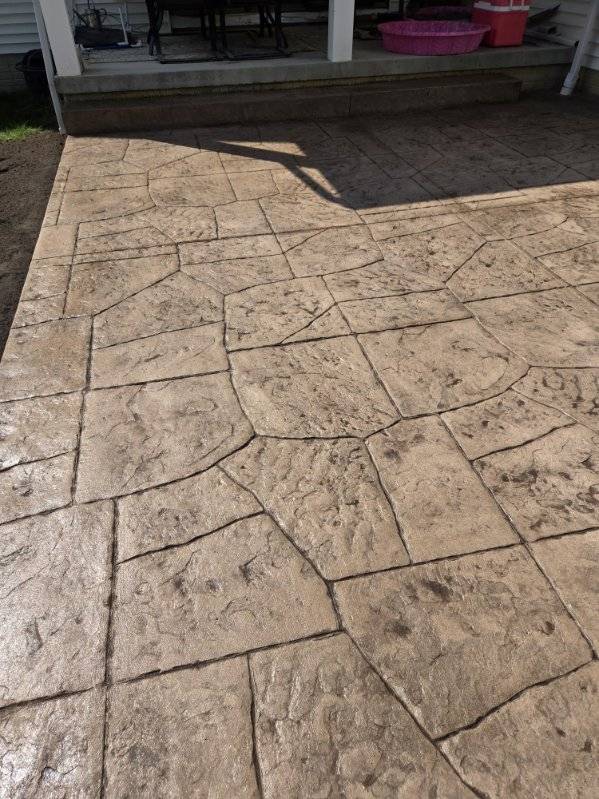
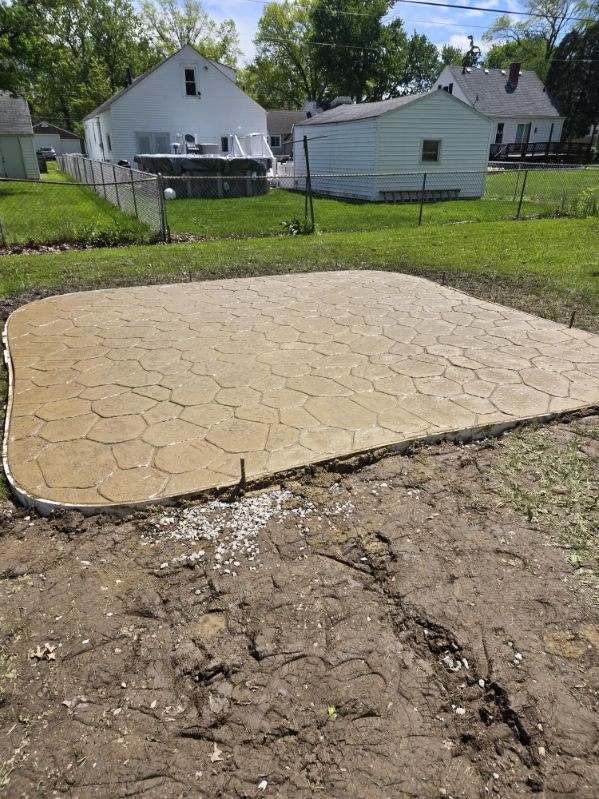
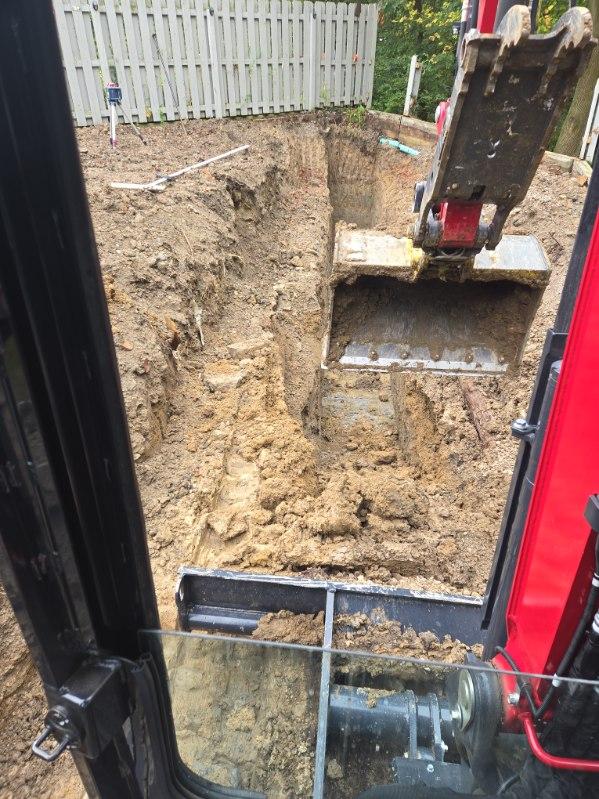
Clean Construction / Stamped Concrete Patios / Strongsville, Ohio
Stamped concrete patios for Strongsville — pool decks, walkout-level patios, and HOA-friendly designs. Air-entrained concrete on compacted base, poured and finished with the owner on site.
Strongsville backyards were built for patios — flat, fenced, and framed by the kind of colonials that look better with a finished outdoor floor behind them. What most of them got instead was a 12x12 builder slab. Replacing that slab with a stamped patio scaled to the actual yard is one of the most transformative dollar-for-dollar projects Brad does in Cuyahoga County.
Strongsville also means pool decks and walkout lots. Stamped concrete around a pool gets a texture chosen for bare feet and slip resistance, expansion detailing at the pool coping, and drainage that keeps splash water moving away. Walkout-basement lots get patios at the lower level designed to handle the roof and deck runoff coming down from above — a detail that decides whether the space stays usable or stays damp.
Where an HOA reviews exterior work, Brad's color and pattern documentation makes approval straightforward. The pour itself is the standard Clean Construction winter-country spec: compacted gravel base, air-entrained mix, control joints cut where movement wants to go, pitch away from the foundation, sealer after cure. At-grade flatwork usually doesn't need a city permit; anything beyond it, Brad confirms with the Strongsville Building Department first.
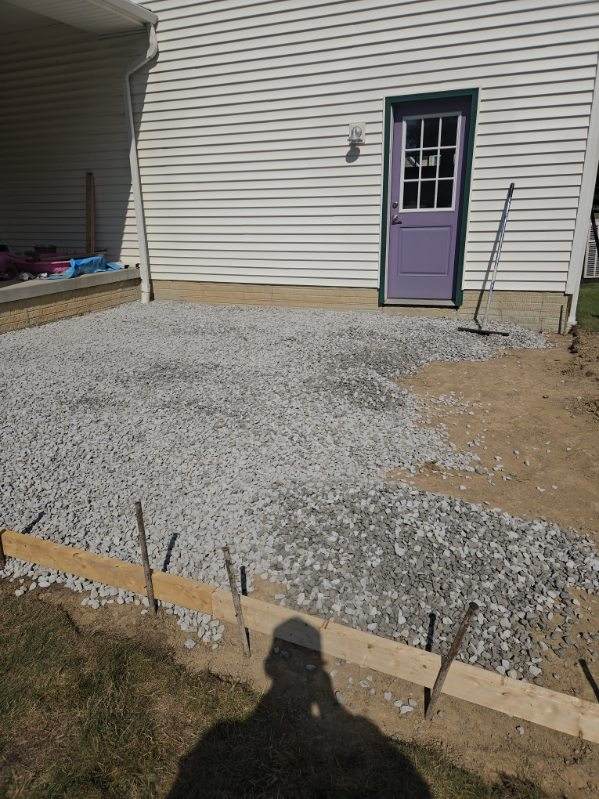
The clay around Strongsville swells wet and heaves frozen, and a slab poured straight onto it is a crack pattern waiting to happen. Every Clean Construction patio starts with excavation and a compacted gravel base — a drainage layer between your concrete and the ground that moves.
Ohio winters destroy ordinary concrete from the inside — trapped water freezes, expands, and pops the surface. Brad pours an air-entrained mix built for freeze-thaw country, so the surface that looks like stone keeps looking like it.
Concrete moves; the craft is deciding where. Joints get cut where the slab wants to crack so movement happens invisibly inside a joint instead of across the face of your stamp pattern.
The surface gets pitched to shed water away from your foundation, sealed after cure, and handed over with real care instructions — including the one nobody mentions: no salt the first winter. Resealing every few years keeps the color deep.
More projects, including decks, retaining walls, and additions, in the full portfolio.
Rough size, how you want to use it — dining, fire pit, hot tub — and any patterns you've seen and liked. Photos of inspiration help. Vague is fine.
He reads the grade, the drainage, the soil, and how the space connects to your doors and yard. Pattern and color samples come out here — chosen against your actual house, not a catalog page.
Excavation, base, concrete, stamping, color, sealer — line by line. If steps, borders, or pads are in the plan, they're priced in plain sight. Money is settled in the contract before anything starts.
Base compacted and inspected by Brad, forms set, concrete placed and stamped in one coordinated push, joints cut, and sealer applied after cure. You get honest cure-time guidance — the patio is worth the one-week wait before the furniture goes on.
Usually not — at-grade concrete flatwork is typically exempt from building permits. The picture changes when the project grows steps, seat walls, footers, or a covered structure. Brad confirms the requirements with the City of Strongsville Building Department before work starts, so nothing gets built twice.
All concrete moves — the honest answer is that the craft is controlling where. An air-entrained mix on a compacted base, with control joints cut where the slab wants to move, keeps cracking inside the joints and out of sight. Random surface cracks are what happens when those steps get skipped.
Both can look great. Stamped concrete is one monolithic pour — no individual pieces to settle, shift, or grow weeds between — and it's typically the better value for larger patios. Pavers win when future access under the patio matters or repairs need to be piece-by-piece. Brad will give you a straight comparison for your yard rather than a sales pitch.
Lightly. Rinse or mild-soap wash when it needs it, reseal every two to three years to keep the color deep and the surface protected, and keep de-icing salt off it the first winter while the concrete finishes curing. That's the whole regimen.
It depends on square footage, site prep, pattern, and color complexity, so Brad doesn't quote blind. He walks the yard, then you get a written, itemized estimate — excavation through sealer, every line explained. The site visit and estimate cost you nothing.
Yes — pool decks are stamped concrete's best use case, with three Strongsville-specific details done right: a finish textured for wet bare feet, isolation joints at the coping so pool shell and deck can move independently, and pitch that carries splash and rain away from both the pool and the house. Color choice matters too; lighter tones stay cooler underfoot in July.
Fill this out or call him directly. Either way you're talking to the person who builds it.
Brad will call you back the same day. If it's urgent, call him directly at 440-315-4438.